While there's a whole branch of physics called statistical physics (probably a misleading title) physicists often get only a few hours of statistical training in their undergraduate degrees. This is surprising to some who think of physicists as the most mathematical of scientists. In fact you can find a diversity of statistical crimes/accidents in physics papers (and I'm sure you can find them in my own). In partial acknowledgement of this, I organised this Royal Society Discussion Meeting and edited this volume of the Philosophical Transactions of the Royal Society “Signal Processing and Inference for the Physical Sciences” with the excellent Prof Tom Maccarone (now at Texas Tech Astrophysics and Astronomy). Our goal was to expose physical scientists to some new topics in statistical inference and some data analysts to physical challenges. Lots of the volume is free and there are also talks from the authors and slides on this page. We provide an introduction "Inference for the Physical Sciences" which we hope can serve as a jumping off point for physical scientists wanting to use statistical tools. Max Little also wrote an article highlighting some challenges in signal processing in biophysics "Signal processing for molecular and cellular biological physics" putting some of our other work in context (see previous blog articles on finding steps beneath the noise and on molecular dance steps). For those with an interest in Machine Learning I think the talks by Bishop, Gharamani, Roberts and Hyvärinen are worth a look. Nick
Tuesday, 29 January 2013
Wednesday, 3 October 2012
Exploring noise in cellular biology
We're used to thinking about machines as robust, hard-wearing objects made from solid materials like metal and plastics. If they crack, split or overheat they are liable to malfunction, and if we subject them to too much jostling and shaking we're asking for trouble. However, the biochemical machines responsible for keeping us alive work in a rather different world -- they're made from soft, organic materials, and contained in a disorganised bag (the cell) that is constantly shaken, bumping our machines against each other and other cellular inhabitants. How can the delicate processes required by living organisms take place in this chaotic environment? And how can scientific progress be made in such a tumultuous, unpredictable world?
![]() |
| Extrinsic factors can modulate the stability of essential, but noisy, cellular circuits |
Iain recently wrote an article, targeted at a broad audience, looking at some of these questions. One of the most important cellular processes that has to take place in this chaotic world is that of 'gene expression': the interpretation of genetic blueprints which describe how to build cellular machinery, and the subsequent construction process. Gene expression can be likened to using a bad photocopier to copy books from a library that opens and closes randomly, then using these photocopies (which are prone to decay) to construct machines. This problematic environment gives rise to many medically important random effects, including bacterial resistance to antibiotics and differing responses to anti-cancer drugs. We are particularly interested in how fluctuating power supplies (see our other blog articles here, here and here!) influence the cell's ability to produce these machines, and what effects this unreliable power has on medically important processes. The article -- available here and appearing in the expository magazine Significance -- takes a look at how cellular noise arises, current techniques for its detection and analysis, and its influence on important biological phenomena. Iain
Sunday, 23 September 2012
Organizing networks using their dense regions
Many systems in fields ranging from biology to sociology, to politics and finance can be represented as networks. For example, in protein interaction networks each node represents a protein and each link, connecting a pair of nodes, quantifies the strength of the interaction between those proteins. Similarly, in political voting networks nodes represent politicians and the edges connecting pairs of politicians represent the similarity of their legislative voting records. Despite the significant differences in the underlying systems, the common network representation enables researchers in different fields to ask questions that can be surprisingly similar. Given this, it would be useful to have a systematic method to highlight similarities in networks from different fields to identify problems that might be tackled using the same techniques. For example, if a biological network representing covariation in neural activity in different regions of the brain could be shown to be structurally similar to a financial network representing correlation of stock returns, certain analytical tools and models might be applicable to both problems.
In our paper, we tackle this problem by first developing a method to quantify the similarity of different networks based on their community structure. A community in a network, loosely put, is a set of nodes which are more connected to each other than they are to the rest of the network (like a group of friends who have the majority of the social interactions with each-other). We introduce the idea of “mesoscopic response functions” which are curves that summarize the community structure of each network at different scales and enable us to define a single number that quantifies the similarity of network pairs. Importantly, this approach allows us to compare networks with different numbers of nodes and different link densities. We then use this similarity measure to construct taxonomies of networks. From an historical perspective, classification of objects in this way has been central to the progress of science, as demonstrated by the periodic table of elements in chemistry and the phylogenetic tree of organisms in biology.
The taxonomies constructed using our approach are successful at grouping networks that are known to be similar. For example, political voting networks for the US Congress, UK House of Commons and United Nation are clustered together in the same group. Perhaps more importantly, the method also identifies networks that are not grouped with members of the same class and are therefore unusual in some way. For example, a Facebook network for Caltech is not grouped with the Facebook networks of other universities. We also used the technique to detect historically significant financial and political changes in temporal sequences of networks; we found the stock market network corresponding to the 1987 crash and the voting network corresponding to the American Civil War to stand out from their respective sequences of networks.
![]() |
| A taxonomy of networks |
In our paper, we tackle this problem by first developing a method to quantify the similarity of different networks based on their community structure. A community in a network, loosely put, is a set of nodes which are more connected to each other than they are to the rest of the network (like a group of friends who have the majority of the social interactions with each-other). We introduce the idea of “mesoscopic response functions” which are curves that summarize the community structure of each network at different scales and enable us to define a single number that quantifies the similarity of network pairs. Importantly, this approach allows us to compare networks with different numbers of nodes and different link densities. We then use this similarity measure to construct taxonomies of networks. From an historical perspective, classification of objects in this way has been central to the progress of science, as demonstrated by the periodic table of elements in chemistry and the phylogenetic tree of organisms in biology.
The taxonomies constructed using our approach are successful at grouping networks that are known to be similar. For example, political voting networks for the US Congress, UK House of Commons and United Nation are clustered together in the same group. Perhaps more importantly, the method also identifies networks that are not grouped with members of the same class and are therefore unusual in some way. For example, a Facebook network for Caltech is not grouped with the Facebook networks of other universities. We also used the technique to detect historically significant financial and political changes in temporal sequences of networks; we found the stock market network corresponding to the 1987 crash and the voting network corresponding to the American Civil War to stand out from their respective sequences of networks.
You can read the full story in our paper “Taxonomies of networks from community structure” in Physical Review E 86, 036104 (2012) In the paper, we demonstrate the range of fields in which this approach can be usefully applied using a set of 746 networks and case studies that include US Congressional voting, Facebook friendship, fungal growth, United Nations voting, and stock market return correlation networks. Dan, JP and Nick
Friday, 21 September 2012
How conserved are protein-protein interactions? And why would you want to know?
A comparison of biological sequences from multiple species shows a great deal of evolutionary conservation. An overall question of interest is the following: what is the connection between similarities in biological sequence between species and similarities in the function of their components and cells?
We started to think about this question in the specific context of proteins: the construction blocks of cells which are specified by a sequence (of amino acids). If two human proteins are known to physically interact (stick to each other) will their equivalent (homologous) proteins in mouse physically interact? (To say that two proteins are homologous means that they are similar through common evolutionary descent: in some sense, they are the 'same' protein).
The answer, it is often assumed, is 'yes': a fairly similar sequence that specifies the protein makes for a fairly similar function of that protein. Indeed, partly because new sequence data is being generated at a much faster rate than any other type of data, it is common practice to 'transfer' functional knowledge (such as interaction partners) from a functionally characterised protein to its unstudied matches in other species. But is this legitimate?
An answer could also shed light on more theoretical questions.
- If only small changes in sequence can lead to new interactions between proteins, then this could be a fast evolutionary mechanism to generate new functions.
- Homologs are also found within a species - do these maintain the same interactions (a form of robustness), or rapidly lose them (release from evolutionary selection)?
Our paper just appeared in PLoS Computational Biology with the title "What Evidence is There for the Homology of Protein-Protein Interactions?". Our results returned some expected conclusions: more closely related species have more conserved interactions; the more stringent the definition to consider two proteins as homologs, the more conservation observed. An overall conclusion was that, at definitions of homology/similarity frequently used in the community, conservation of interactions is low, and hence 'transferred' functional annotations should be used with care. We also compared the transfer of interactions between and within species, and found within-species transfers were less reliable than between-species transfers. Using our method we also made some guesses as to the rate at which protein-protein interactions are lost through evolutionary time and about the total number of interactions that are present between all the proteins in an organism.
Our work is preliminary in many ways: better attempts at dealing with interaction data errors could be made; we treated all the interactions as independent of each other, which of course they are not; we didn't compare our derived rate of loss of interactions with other evolutionary rates; and much else besides! Hopefully someone else will pick up where we have left off... Anna and Nick
We started to think about this question in the specific context of proteins: the construction blocks of cells which are specified by a sequence (of amino acids). If two human proteins are known to physically interact (stick to each other) will their equivalent (homologous) proteins in mouse physically interact? (To say that two proteins are homologous means that they are similar through common evolutionary descent: in some sense, they are the 'same' protein).
The answer, it is often assumed, is 'yes': a fairly similar sequence that specifies the protein makes for a fairly similar function of that protein. Indeed, partly because new sequence data is being generated at a much faster rate than any other type of data, it is common practice to 'transfer' functional knowledge (such as interaction partners) from a functionally characterised protein to its unstudied matches in other species. But is this legitimate?
![]() |
| If we know the interaction between proteins in the network of the green organism what can we say about the interactions of similar proteins in the blue organism's network? |
An answer could also shed light on more theoretical questions.
- If only small changes in sequence can lead to new interactions between proteins, then this could be a fast evolutionary mechanism to generate new functions.
- Homologs are also found within a species - do these maintain the same interactions (a form of robustness), or rapidly lose them (release from evolutionary selection)?
Our paper just appeared in PLoS Computational Biology with the title "What Evidence is There for the Homology of Protein-Protein Interactions?". Our results returned some expected conclusions: more closely related species have more conserved interactions; the more stringent the definition to consider two proteins as homologs, the more conservation observed. An overall conclusion was that, at definitions of homology/similarity frequently used in the community, conservation of interactions is low, and hence 'transferred' functional annotations should be used with care. We also compared the transfer of interactions between and within species, and found within-species transfers were less reliable than between-species transfers. Using our method we also made some guesses as to the rate at which protein-protein interactions are lost through evolutionary time and about the total number of interactions that are present between all the proteins in an organism.
Our work is preliminary in many ways: better attempts at dealing with interaction data errors could be made; we treated all the interactions as independent of each other, which of course they are not; we didn't compare our derived rate of loss of interactions with other evolutionary rates; and much else besides! Hopefully someone else will pick up where we have left off... Anna and Nick
Predicting network flows
Many biological,
geophysical and technological systems involve the transport of material over a
network by bulk fluid flow (advection) and diffusion within that fluid. The
analogy is that ink spilled in the middle of a river both spreads out
symmetrically by diffusion (even if the river were stationary) and also gets
transported bodily with the flow of the river (advection). Bulk fluid transport
systems are found in the vast majority of multi-cellular organisms, as the
component cells of such organisms require resources for metabolism and growth,
and the speed of diffusion alone is often such that it is only an effective
means of exchange at microscopic length scales.
Molecules of interest are carried by advection and diffusion through the
networks that make up fungi, the blood vessel networks of animals, the xylem
and phloem elements of plants, and various body cavities of many different
animals. Advection and diffusion are also fundamental to transport in
geological and technological systems, such as rivers and drainage networks, gas
pipelines, sewer systems and ventilation systems.
In all of these
cases the particles of interest diffuse within a moving fluid, which is
constrained to flow within a given network. Furthermore, the molecules that are
carried through the network may be consumed or delivered out of the network at
a particular rate. For example, glucose molecules are carried through the blood,
and at each point in the network there is some probability that a given glucose
molecule will be transported out of the vascular system and into the
surrounding tissue. We have recently developed an algorithm for predicting how the spatial distribution of nutrients in a network will vary
over space and time, when the resource in question is subject to given rates of
advection, diffusion and delivery. We explain the algorithm in our paper "Advection, diffusion, and delivery over a network" that recently appeared in Physical Review E.
We are
particularly interested in modeling the movement of radio-labelled tracers in growing
fungal networks. As mentioned in a previous post,
we hypothesize that within fungal networks, there is a bulk movement of fluid
from the sites of water uptake to the sites of growth. To test this hypothesis,
we allowed the fungi Phanerochaete
velutina
to
grow on a dish for a four week period,
taking photographs every three days. An
image analysis program was then used to convert the
sequence
of photographs into a sequence of networks,
comprised
of edges of measured length and volume.
After taking a
final photograph of our fungi, we added a radio-labelled tracer, placed a
scintillation screen over the network, and used a photon counting camera to see
where the tracer moved. This experiment gave us empirical data which we could
use to evaluate our model of transport in fungal networks. Our model has one
free parameter, corresponding to the fraction of each edge that is occupied by
transport vessels. We found that our model (see Fig. d) of growth-induced mass
flows was remarkably good at
predicting where the tracers would spread (compare to Fig c), if we make the
biologically plausible assumption that the fluid flows occur within transport
vessels that occupy 10% of each edge in the network. Luke and Nick
Thursday, 5 April 2012
Educated guesses about ancestral shapes and sounds: what do dead languages like Latin and Greek sound like?
What might ancient creatures have looked like? What would dead languages have sounded like? And what are the evolutionary relationships between currently observed shapes and sounds? While we have widely accepted methods that allow us to speculate (in an educated fashion) about ancestral genetic sequences we don't have well developed approaches for shapes and
functions.
I proposed to John Moriarty that we attempt to extend sequence inference to functions, and we got a grant with some most excellent colleagues John Aston, Dorothy Buck and Vincent Macaulay. John and I wrote a paper in which we investigated this using the versatile mathematical tools that are Gaussian Processes. We showed that in some controlled settings we could take (functional) observations from the world and make sensible guesses about what their ancestors might have been. If you want to see a video of us implementing an experiment with the help of some school children then click here (a blog specifically about our school engagement is here). More or less, our task is to take the game of telephone and run it backwards to identify the original sound (a sound can be viewed as a curve, or function on the line, or as, e.g., a spectrogram, a function on the plane).
But once you suppose you can reconstruct original sounds from mutated versions then one might hope to engage with some big and old questions: what do dead languages like Latin and Greek sound like? Can we use observations of contemporary speech sounds made at different leaves of linguistic trees (see the picture below) "to put probability distributions over" (make educated guesses about) possible ancestral speech sounds? One takes an audio recording of the same (sufficiently homologous) word in multiple different languages and attempts to make (probabilistic) inferences about the corresponding ancestral sounds.
We just wrote a relatively non-technical paper in Trends in Ecology and Evolution "Phylogenetic inference for function-valued traits: speech sound evolution" (free version here and not free version here) with authors: John Aston (Warwick Stats) Dorothy Buck (Imperial Maths), John Coleman (Oxford Phonetics), Colin Cotter (Imperial Aero), NJ, Vincent Macaulay (Glasgow Stats), Norman Macleod (Natural History Museum), John Moriarty (Manchester Maths), Andrew Nevins (UCL Linguistics). In this we suggest that we have all the tools to try to reconstruct ancient speech (we also have lots of people with strong opinions about what ancient speech might have sounded like). We also use the paper to emphasise that this approach could allow us to reconstruct evolutionary trees from (functional) data. John Coleman says that they're (informally) calling this activity of reconstructing past speech sounds, necro-phonetics. I think that's neat. Nick
I proposed to John Moriarty that we attempt to extend sequence inference to functions, and we got a grant with some most excellent colleagues John Aston, Dorothy Buck and Vincent Macaulay. John and I wrote a paper in which we investigated this using the versatile mathematical tools that are Gaussian Processes. We showed that in some controlled settings we could take (functional) observations from the world and make sensible guesses about what their ancestors might have been. If you want to see a video of us implementing an experiment with the help of some school children then click here (a blog specifically about our school engagement is here). More or less, our task is to take the game of telephone and run it backwards to identify the original sound (a sound can be viewed as a curve, or function on the line, or as, e.g., a spectrogram, a function on the plane).
But once you suppose you can reconstruct original sounds from mutated versions then one might hope to engage with some big and old questions: what do dead languages like Latin and Greek sound like? Can we use observations of contemporary speech sounds made at different leaves of linguistic trees (see the picture below) "to put probability distributions over" (make educated guesses about) possible ancestral speech sounds? One takes an audio recording of the same (sufficiently homologous) word in multiple different languages and attempts to make (probabilistic) inferences about the corresponding ancestral sounds.
Tuesday, 20 March 2012
Taking the pulse of cellular power stations
Discharge and recharge: why cellular power stations might pulse
We've just written an article in the journal Plant Cell about pulsing cellular power-stations and will motivate it by an analogy. Imagine we have a reservoir of water, and this water flows downhill through an outlet pipe, turning a turbine and producing energy. In this thought experiment, we're faced with a problem: the only way we can get water into our reservoir is by pumping it into the bottom of the reservoir. The higher up a reservoir is, the harder it is to pump water up there and the higher the risk of pumps overheating and getting damaged.
The problem can be solved by allowing the height of our reservoir to vary. If we lower our reservoir, it will become easier to fill, and the higher water pressure that arises from an increasingly filled reservoir will partly compensate for the fact that turbine-turning water will flow downhill from a lowered height, while allowing the pumps to relax and cool.
This model is a crude representation of mitochondria, the power stations of the cell, which use energy from respiration to create an energetic gradient across their membranes -- like a natural version of an AA battery. In our picture, this corresponds to the pumps feeding into our reservoir -- and in the cell, these pumps produce dangerous chemicals when they are overworked. The gradient they produce imbues protons with energy that is part electrical -- which we picture as the height of our reservoir -- and part chemical -- which we picture as the amount of water in our reservoir. These protons then flow through a protein complex -- the turbine -- to produce ATP, the universal cellular fuel.
When mitochondria pump many protons, their "reservoirs" rise, with the increase in height forcing the pumps to work harder to pump water into the reservoir. This work produces dangerous chemicals which can damage the cell and the mitochondria themselves (called reactive oxygen species - they're what antioxidants try to combat). We have found a new mechanism by which this risk is decreased: if mitochondria are having to work hard, they "pulse", spontaneously lowering the height of their reservoir. This decreases the amount of work that the mitochondrial pumps have to do to fill the reservoir. The amount of turbine-turning energy per unit of water decreases, but as it becomes easier to fill the reservoir, more water gets pumped into it, partly compensating for the loss of height by an increase in volume. The pulsing process thus lowers the reservoir but fills it with more water, allowing the mitochondrial pumps to relax and reducing the production of dangerous chemicals.
We observed these pulses, spontaneous decreases of mitochondrial membrane potential, in Arabidopsis thaliana, a model plant species used in many biological contexts. Treating plant mitochondria with a variety of chemicals and observing the effects on pulsing, we deduced a biochemical mechanism by which pulsing occurs: a controlled influx of cations such as calcium ions into the mitochondrial matrix decreases membrane potential. We also found that pulsing is increased when plants face stressful environments: if they are suddenly heated, for example, or exposed to toxic chemicals. This novel mechanism may help explain some of the variability that our cellular engines exhibit and may be an important discovery in considering how mitochondria react to dangerous cellular conditions. You'll find the article free by following this link. This article about single mitochondria complements our work on the mitochondrial population of the cell - we blogged about that here and here. Iain, Markus & Nick.
This model is a crude representation of mitochondria, the power stations of the cell, which use energy from respiration to create an energetic gradient across their membranes -- like a natural version of an AA battery. In our picture, this corresponds to the pumps feeding into our reservoir -- and in the cell, these pumps produce dangerous chemicals when they are overworked. The gradient they produce imbues protons with energy that is part electrical -- which we picture as the height of our reservoir -- and part chemical -- which we picture as the amount of water in our reservoir. These protons then flow through a protein complex -- the turbine -- to produce ATP, the universal cellular fuel.
When mitochondria pump many protons, their "reservoirs" rise, with the increase in height forcing the pumps to work harder to pump water into the reservoir. This work produces dangerous chemicals which can damage the cell and the mitochondria themselves (called reactive oxygen species - they're what antioxidants try to combat). We have found a new mechanism by which this risk is decreased: if mitochondria are having to work hard, they "pulse", spontaneously lowering the height of their reservoir. This decreases the amount of work that the mitochondrial pumps have to do to fill the reservoir. The amount of turbine-turning energy per unit of water decreases, but as it becomes easier to fill the reservoir, more water gets pumped into it, partly compensating for the loss of height by an increase in volume. The pulsing process thus lowers the reservoir but fills it with more water, allowing the mitochondrial pumps to relax and reducing the production of dangerous chemicals.
We observed these pulses, spontaneous decreases of mitochondrial membrane potential, in Arabidopsis thaliana, a model plant species used in many biological contexts. Treating plant mitochondria with a variety of chemicals and observing the effects on pulsing, we deduced a biochemical mechanism by which pulsing occurs: a controlled influx of cations such as calcium ions into the mitochondrial matrix decreases membrane potential. We also found that pulsing is increased when plants face stressful environments: if they are suddenly heated, for example, or exposed to toxic chemicals. This novel mechanism may help explain some of the variability that our cellular engines exhibit and may be an important discovery in considering how mitochondria react to dangerous cellular conditions. You'll find the article free by following this link. This article about single mitochondria complements our work on the mitochondrial population of the cell - we blogged about that here and here. Iain, Markus & Nick.
Tuesday, 24 January 2012
How cellular power stations might fluctuate
Mitochondria are the tiny engines of eukaryotic cells (the cells of animals, plants and fungi) -- responsible for producing the energy vital for fundamental processes of life. A recent explosion of experimental results has shown that their behaviour is far more dynamic and rich than any man-made engine. They move through cells, fuse into large networks, break apart, replicate and get degraded if they don't perform adequately.
Mitochondrial populations are also observed to differ significantly between otherwise similar cells: one cell may possess many efficient engines, while another must make do with a small number of inefficient ones (see our blog entry here). As well as explaining why the error-bars in biology can be so big, this cell-to-cell variability in mitochondria can lead to profound medical consequences: many diseases are known to result from low quality mitochondria, unable to produce enough energy for a cell to remain healthy. Mitochondria (and mechanisms to keep their quality high) have been implicated in ageing and diseases like Parkinson's, Alzheimer's, diabetes and cancer.
We have recently produced a mathematical model (coupled to some new experimental data) to give an explanation as to how experimentally observed variability in mitochondrial populations arises and explore its potential consequences: ranging from differences in the rate at which fundamental biochemical elements like mRNAs and proteins are produced, to differences in the stability and ultimate fate of stem cells. Our model is physically simple (we suggest several future experimental directions which would help in further development) and can mathematically be combined with other descriptions of cellular processes, providing a general framework to investigate the biologically and medically important effects of mitochondrial variability. It appeared in PLoS Computational Biology (an open-access journal) under the title "Mitochondrial Variability as a Source of Extrinsic Cellular Noise" but you can also find it here. Iain and Nick.
Tuesday, 19 July 2011
Finding steps beneath the noise

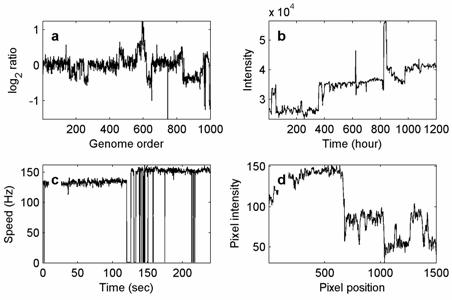
The problem of noise removal from signals (a signal is just a sequence of measurements of some quantity like a wind speed or stock price) which are secretly composed of steps is surprisingly common and important, and arises in a host of disciplines, including analysis of drill hole data in exploration geophysics, detecting DNA copy-number ratios in genomics, and separating out molecular dynamics from background noise. In each case one seeks to filter away the fluctuations in one's signal to leave behind the steps one believes are contained within.
Our recent papers with the glamourous titles Generalized methods and solvers for noise removal from piecewise constant signals I. Background theory and II New Methods (articles free online), which appeared in the Proceedings of the Royal Society A, introduced a new mathematical framework for the problem, and, as special cases of this framework, developed some new signal processing algorithms to address the problem. The study of this task has been very fragmented across disciplines (from geoscience to physics to biology) so one of our major goals was to present a synthesis of existing work which would expose natural developments. For example having performed our synthesis we presented a particularly simple new method called "robust jump penalization", that exhaustively tests for the location of a new step when the noise is not from a normal or Gaussian distribution while subject to the constraint that the number of jumps should be small. Max and Nick
Wednesday, 6 July 2011
Bringing the dance steps of molecular motors into focus
We're all familiar with the behaviour of objects at everyday sizes: if they are heavy, they stay put due to friction, and it's difficult to get them to move anywhere quickly unless you use a lot of force. If instead they are very light, then they can get smoothly carried around on air currents like a feather. That's just a couple of intuitive analogies that don't work at all at the molecular scale! Down inside the workings of cells, at the scale of molecules, everything is constantly buzzing around due to thermal effects and collisions with other molecules scramble up the motion. So simply scaling down our everyday machines might not be the best way to function in this noisy environment. Yet, life is not just a mash of molecules: there are exquisite mechanisms inside cells for doing things (fairly) reliably and repeatably. This includes the rather amazing bacterial flagellar rotary motor that cells use to propel themselves towards their food (fun cartoon of its assembly). It has long been hypothesised that the motor action has to be made in lots of tiny little steps, because this is the only way for a molecular scale machine to efficiently use the available (free) energy to work against the thermal noise that wants to dissipate any organized motion.Biological physicists (like Richard Berry and his team) are intently interested in understanding exactly how this stepping motor works, and they have recently been able to develop the instrumentation to start answering these kinds of questions. Our group is interested in how life deals with fluctuations so we were very interested in their work. Note that you can't use microscopy techniques like conventional electron microscopy, because you have to kill the cell in order to image it. Then you have no chance of seeing the motor in action.
Because of the jostling microscopic environment the data produced by these new systems can be very noisy. We developed statistical methods that tried to separate out the physics we did know (aspects of mechanics and thermal noise) from the biological physics we didn't (how the motors actually steps between successive molecular configurations). This is where statistical modelling comes in: it turns out that the problem of separating step-like motion from the noise in the data so you can image the step-like motion is difficult unless you invoke non-traditional signal processing methods. You also need to take account of the experimental apparatus that introduces some unavoidable lag into the system (Richard's team attaches a tiny bead to the flagellum and tracks this bead). In our soon-to-be-published Biophysical Journal paper "Steps and bumps: precision extraction of discrete states of molecular machines using physically-based, high-throughput time series analysis" (you'll find a pre-print on our publications page), we also introduced a novel technique based on a kind of probabilistic periodicity detection, for teasing out the cylindrical arrangement of proteins that make up the main structure of the motor, which gives the motor a characteristic set of "dance steps". Max and Nick
Friday, 1 July 2011
Power and genes: effects of mitochondrial variability

Cells make stuff and they need power to do this. But what would happen if their power stations were as variable as wind power? Presumably you'd expect that, for cells with a lower average supply of power, they would make stuff (e.g. proteins and protein precursors called RNA transcripts) more slowly and take longer to go forth and multiply (move through their cell cycle). Since you'd imagine that these consequences of power supply variability would be as disadvantageous for the cell as power-cuts for us, I would have guessed that this kind of variability in power would be tightly controlled by the cell. Seems maybe not.
Francisco Iborra now at the Centro Nacional de Biotecnologica in Madrid came to me with some startling data that he had been producing, along with his student Ricardo Neves (now at Biocant in Portugal) and others at the Weatherall Institute for Molecular Medicine. It suggested that maybe cells do show a form of marked power variability: some cells appear to be making gene products faster than others (the picture shows variability in the rate at which gene transcripts are made between cells - each cell's nucleus is the circular blob) and this is related to measures of their mitochondrial content (the number of power stations they have). The cells with more mitochondria at birth also appear to divide sooner than more disadvantaged siblings. The paper "Connecting Variability in Global Transcription Rate to Mitochondrial Variability" can be found on our papers page and appeared in PLoS Biology. Becky Ward it takes 30 - was nice enough to blog interestingly about it (she's worth following).
This might seem like a curiosity, but the fact that some cells differ from others can be very important. While we tailor our treatments of sets of cells, like cancers, to typical cells - maybe cells which, by chance, are very atypical (e.g. lazy and power limited) will respond in a very different way. You only need a few such unusual cells to survive your treatment and they'll repopulate your cancer. In fact the study of cellular variability and its origins is now a major field driven by fun researchers like t h e s e. It's still not very clear why two genes in the same organism might co-vary in the levels of their gene products (called extrinsic noise) and our paper makes an experimental contribution to this: we've just finished a paper which combines a mathematical model plus some more experiments to help illuminate our findings further. Nick
Subscribe to:
Posts (Atom)
Cryptic Mitochondrial Mutations and Ageing
Research into the underlying causes and consequences of ageing has long been of interest to scientists, and has resulted in a widely accept...
-
By taking repeated measurements over time we can study the dynamics of our environment – be it the mean temperature of the UK by month, th...
-
With age, our skeletal muscles (e.g. muscle of our legs and arms) work less well. In some people, there is a substantial loss of strength an...